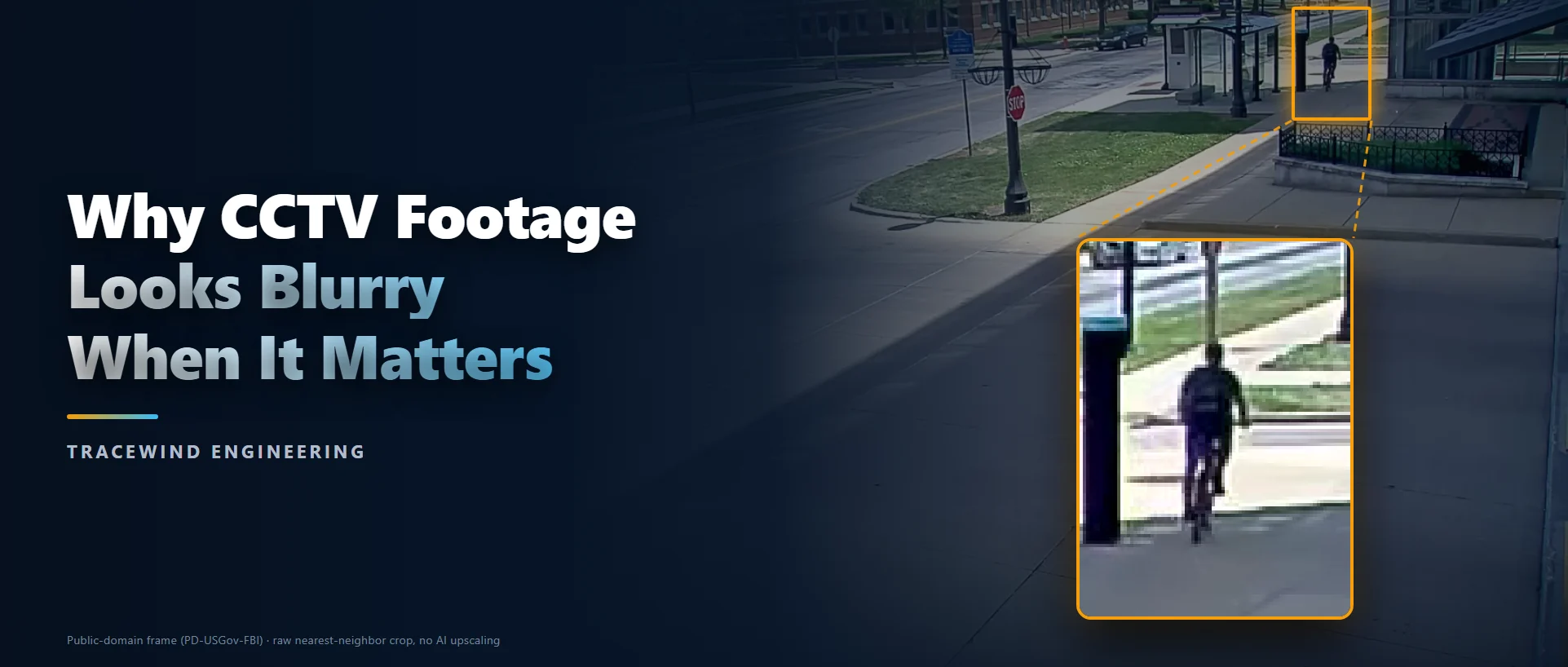
Every time surveillance footage from a major incident goes public, the comment section asks the same question: modern phones shoot crisp 4K video even at night, so why does real CCTV footage still look blurry right when a suspect's face matters most?
The pattern keeps repeating across major cases—even when cameras are everywhere:
In the multi-province Zhou Kehua robbery-homicide series in China (2004–2012), investigators pulled massive volumes of street and bank surveillance footage across cities, yet older camera resolutions, off-axis mounts, lowered baseball caps and deliberate face avoidance meant single frames could not yield facial identification directly.[1]
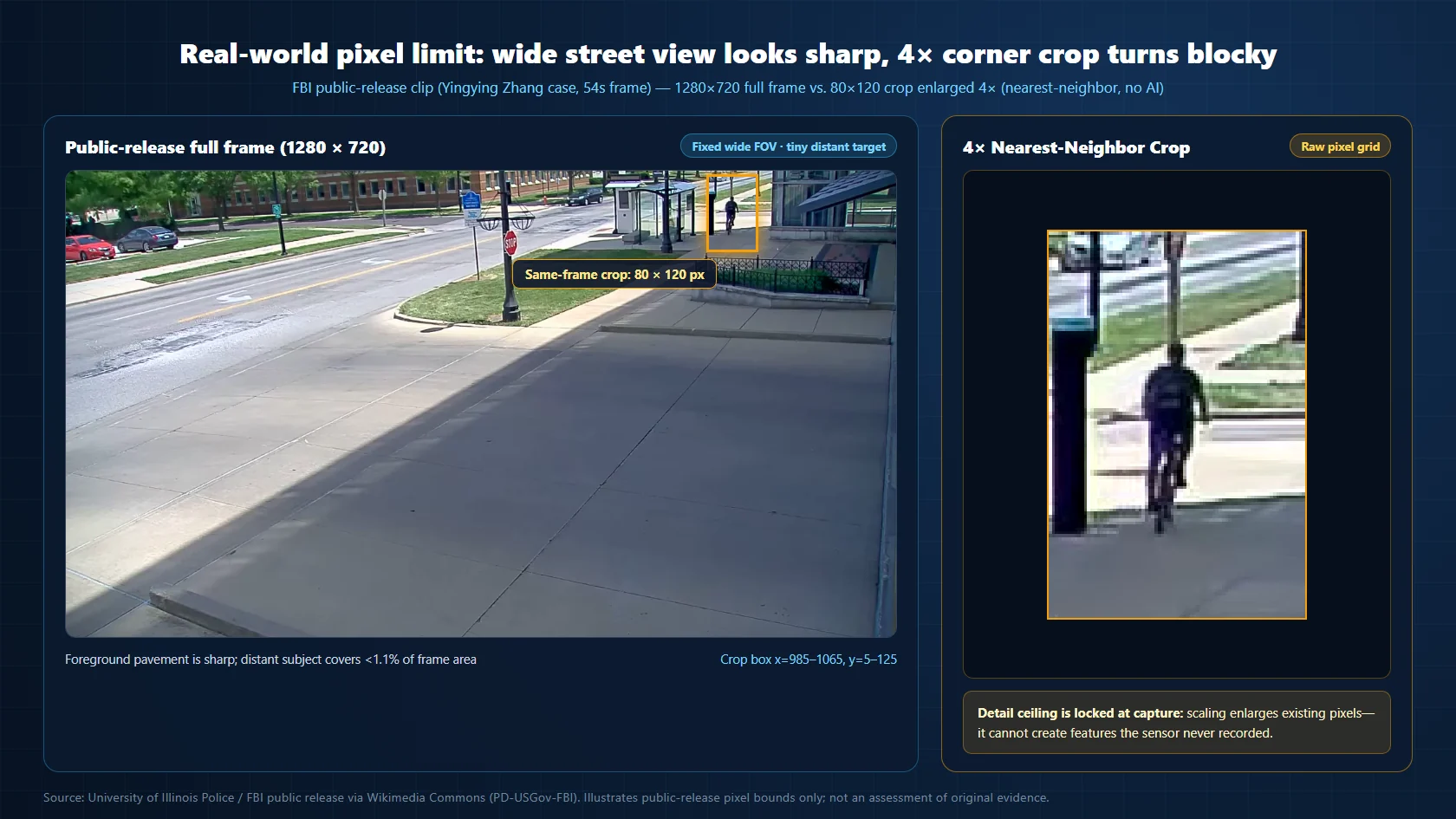
In the 2017 Yingying Zhang case, an FBI public-release surveillance clip captured the entire intersection, traffic signals and vehicle stop cleanly—yet the victim stood near the far edge of a wide-angle lens, leaving only a coarse cluster of pixels around the vehicle and occupants.[2]
Even in camera-dense Midtown Manhattan in December 2024, during the killing of UnitedHealthcare CEO Brian Thompson, a hooded jacket, face mask and turned-away posture defeated automated facial recognition at the primary scene.[3]
Put the conclusion up front: surveillance cameras do not suddenly 'go blurry' during an incident. Most of the time, the system kept recording normally within its configured limits—and after the fact, we ask footage that looked 'good enough' at a glance to answer a question it was never optically equipped to capture.
Recording an event and capturing an identifiable face are two very different thresholds.
01 Fixed mounts meet an uncooperative world
This is the most direct—and most overlooked—physical constraint.
Almost every surveillance camera is installed in advance with a fixed height, fixed orientation and fixed focal length. To cover as much of an intersection, courtyard or corridor as possible with a limited budget, installers routinely pick wide-angle lenses.
Real incidents and suspects never pose for that framing. A subject will not walk calmly into the center of the lens, face the sensor and pause for exposure and focus. Counter-surveillance-minded suspects—whether in historical multi-city investigations or modern Manhattan—wear caps or hoods, pull up masks, hug shadow lines and turn away behind trees, utility poles and passing traffic.
Security engineering uses the international standard IEC 62676-4 (DORI pixel-density tiers) to measure what a camera can actually resolve at distance: roughly 25 pixels per meter is only enough for Detection (seeing someone is there), 63 px/m supports Observation (clothing and posture), 125 px/m approaches Recognition of a familiar person, and reliable Identification of a stranger's facial features typically requires 250 px/m or higher.[4]
That means the same nominally HD camera can resolve sidewalk paving cracks five meters away in razor-sharp detail while reducing a person across the street to a few dozen pixels. Often the whole camera is not blurry—the event simply happened in the sparsest pixel corner of a wide frame.
02 Media cropping scales the canvas, not the captured detail
When an incident sits in a tiny corner of a wide-angle scene, viewers watching the raw frame will not even notice it without arrows or bounding boxes.
Before airing on news broadcasts or posting to social feeds, editors crop that corner and stretch it to fill a 16:9 playback window so phone viewers can follow the action. That edit helps storytelling, but it immediately exposes the raw pixel ceiling.
Take a concrete, verifiable example from the 54-second mark of the FBI's public-release clip in the Yingying Zhang case (1280×720 published resolution): foreground asphalt and street signs look crisp, while the pedestrian area in the upper-right distance occupies an 80×120 pixel crop—less than 1.1% of the frame area. Enlarging that 80×120 crop 4× with nearest-neighbor scaling makes the original blocks larger; it cannot invent facial features that were never sampled.[2]
The arithmetic holds even on a 4K camera. Crop a 240×135 region from the corner of a 3840×2160 stream and scale it to fill a 1920×1080 player window: linear scale increases 8× horizontally and vertically, and screen area balloons 64×. The Scientific Working Group on Digital Evidence (SWGDE) explicitly distinguishes 'enlargement to make existing pixels easier to inspect' from generating details that were not recorded.[5] A 1080p export badge describes the container you are watching, not the spatial detail captured on scene.
03 Three more losses between the lens and your screen
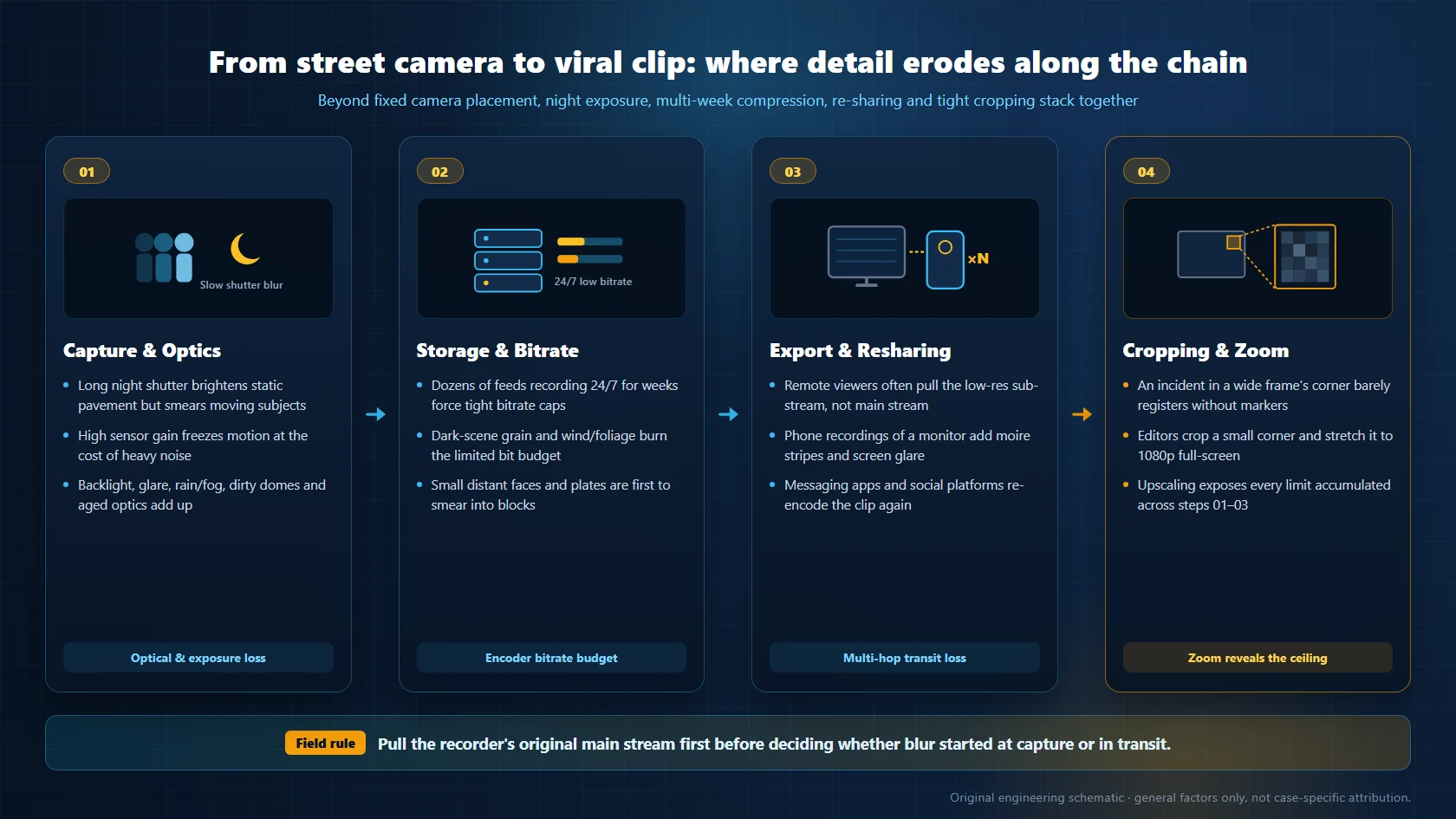
Beyond wide framing and digital zoom, a recording typically passes through three cumulative quality bottlenecks before anyone examines it:
First is the night exposure vs. motion-blur seesaw. At night, cameras slow down the shutter to gather enough light. Static road markings and storefront signs appear reasonably bright, while walking people or moving cars streak across the exposure window. Force a faster shutter to freeze motion, and high sensor gain fills the shadow areas with heavy noise.[6] Add headlight glare, missed focus, dusty weatherproof domes, rain reflections or aging sensors, and a system that looked crisp during daytime handover falls apart on dynamic night detail.
Second is long-retention bitrate compression. A phone records for seconds or minutes with generous megabits per second; a surveillance NVR records dozens of channels 24/7 for weeks or months on a fixed disk budget. Under tight bitrate ceilings, dark-scene sensor noise and swaying trees consume the bit budget first, leaving the encoder to quantize small distant subjects into flat macroblocks.[7]
Third is export and multi-hop re-sharing loss. Clips circulating online are frequently not pulled from the recorder's original main stream at all—they start as low-resolution remote-preview sub-streams, phone videos filmed off a monitor screen, chat forwards, editor re-encodes, social platform transcodes and tight crops. Every hop removes information.
Equally important in serious review: stay calibrated. Do not assume an original NVR file must be crystal clear just because a viral clip looks terrible—and do not mistake a third-hand messaging forward for the actual evidential quality sitting on the recorder.
04 Selection bias: we mostly remember the unreadable frames
There is also a non-technical filter shaping public intuition: news feeds and social timelines are not a random sample of CCTV systems.
When a nearby camera captures a clear face, crisp clothing, an unambiguous plate or an unobstructed path, investigators resolve identity quickly through standard workflow—no blurry screengrab needs to be released for public tips, and no frame-by-frame internet debate erupts.
Instead, the clips broadcast widely for public assistance or scrutinized online are disproportionately the difficult ones: long viewing distances, bad lighting, masks, hats and heavy occlusion.
Treat this carefully as an observational selection effect rather than a mathematical rule—high-profile cases with sharp footage still make headlines, and blurry clips do not automatically stall an investigation. Still, it explains why the public impression of 'cameras are always blurry' skews far worse than average real-world deployments.
05 When faces fail: how investigations actually close the gap
If neither old street cameras nor modern Midtown Manhattan always give a clean facial ID on a single frame, how do experienced video investigators bridge blurry footage?
Step one is separating 'blurry at the source' from 'damaged in transit.' Before analyzing any low-quality clip, verify whether you have the original recorder main stream in its native wrapper rather than a remote preview sub-stream, a re-wrapped download or a phone video of a screen. Recovering the raw NVR export almost always recovers more detail than staring harder at a fifth-generation forward.
Step two is refusing to treat generative upscaling as evidence. Consumer expectations often assume AI super-resolution can rebuild a crisp ID portrait from a 15-pixel mosaic. Under forensic video rules, details the lens never sampled can only be hallucinated from training statistics—no matter how sharp those synthesized eyes look, generated features cannot substitute for original scene facts.[5]
Step three—the real turning point in all three public cases above—is shifting from 'fixating on one blurry frame' to 'invariant cues + multi-camera relay.'
In the Zhou Kehua investigation, rather than stalling on obscured faces, analysts focused on invariant behavioral traits across thousands of hours of low-grade video: walking stride, posture rhythm and a frequent over-the-shoulder look-back habit, tracing sightings backward until historical footage yielded an undisguised frontal view.[1]
In the 2024 Manhattan case, when hood and mask blocked facial matching at the shooting site, detectives chained clothing, backpack details and block-by-block timing back through adjacent commercial cameras until a lobby camera at an Upper West Side hostel captured the suspect with his mask briefly lowered.[3]
That is also where practical video investigation software earns its keep: an unreadable face does not mean zero leads. Timestamps, travel direction, gait, clothing colors, carried bags, vehicle silhouettes and companion patterns all narrow the search across dozens of hours and multiple cameras until a closer, cleaner angle turns up—and every candidate hit should jump straight back to the raw main-stream timeline for human verification.

Back to the original question
Why does CCTV footage look blurry when it matters most? Because cameras silently follow pre-set framing and disk budgets, incidents happen off-axis in bad light or behind masks, public clips magnify tiny corner crops to full screen, and human memory remembers the frustrating clips most vividly.
On the prevention side, purposeful DORI placement, night motion testing and maintenance close part of the gap. On the investigation side, retrieving the original recorder stream immediately and relaying non-facial cues across neighboring cameras delivers far more value than wishing one pixelated frame would magically sharpen.
References
- [1] Xinhua / CCTV / People's Daily public reporting on the Zhou Kehua multi-province armed-robbery investigation (2004–2012): extracting gait and habitual look-back traits across thousands of hours of disguised surveillance to trace an unmasked frontal recording.
- [2] FBI, Surveillance Video of Missing Student Yingying Zhang; archived via Wikimedia Commons (PD-USGov-FBI). https://commons.wikimedia.org/wiki/File:Yingying_Zhang_CCTV.webm
- [3] CBS News / The Guardian (Dec 2024), public reporting on NYC surveillance tracking in the Brian Thompson shooting: hood and mask prevented direct identification at the primary scene; cross-block camera tracking located an Upper West Side hostel clip with the mask lowered.
- [4] IEC 62676-4 DORI pixel-density tiers (Detection ~25 px/m, Observation ~63 px/m, Recognition ~125 px/m, Identification ~250 px/m) and Axis Communications, Quality with a purpose. https://whitepapers.axis.com/en-us/quality-with-a-purpose
- [5] SWGDE (Scientific Working Group on Digital Evidence), Fundamentals of Resizing Imagery and Considerations for Legal Proceedings (22-V-001-1.1, Sept 2022). https://www.swgde.org/documents/published-complete-listing/22-v-001-swgde-fundamentals-of-resizing-imagery-and-considerations-for-legal-proceedings/
- [6] Axis Communications, Troubleshooting guide for image quality (low-light shutter speed, motion blur and gain noise trade-offs). https://help.axis.com/en-us/troubleshooting-image-quality
- [7] Axis Communications, Bitrate control for IP video (compression behavior in complex and low-light surveillance scenes). https://whitepapers.axis.com/en-us/bitrate-control-for-ip-video